A story that has set the internet ablaze this week reads like a Hollywood thriller: a lead engineer at Anthropic — one of the world’s most secretive and valuable AI companies — allegedly earning $2.2 million per year, accidentally leaked the company’s internal “Obsidian Brain,” a sprawling knowledge graph containing over 8,893 nodes, 4,729 links, and more than 9,000 interconnected documents — and was reportedly fired the same day.
The post, which crossed over 1.1 million views on X within hours, sent tech Twitter into a frenzy of speculation about what secrets Anthropic’s internal AI “brain” might reveal about the company’s most guarded research. But as with many things that go viral at this speed, the reality behind the story is considerably more nuanced — and significantly less dramatic — than the headline suggests.
What Actually Happened: Separating Fact from Viral Fiction
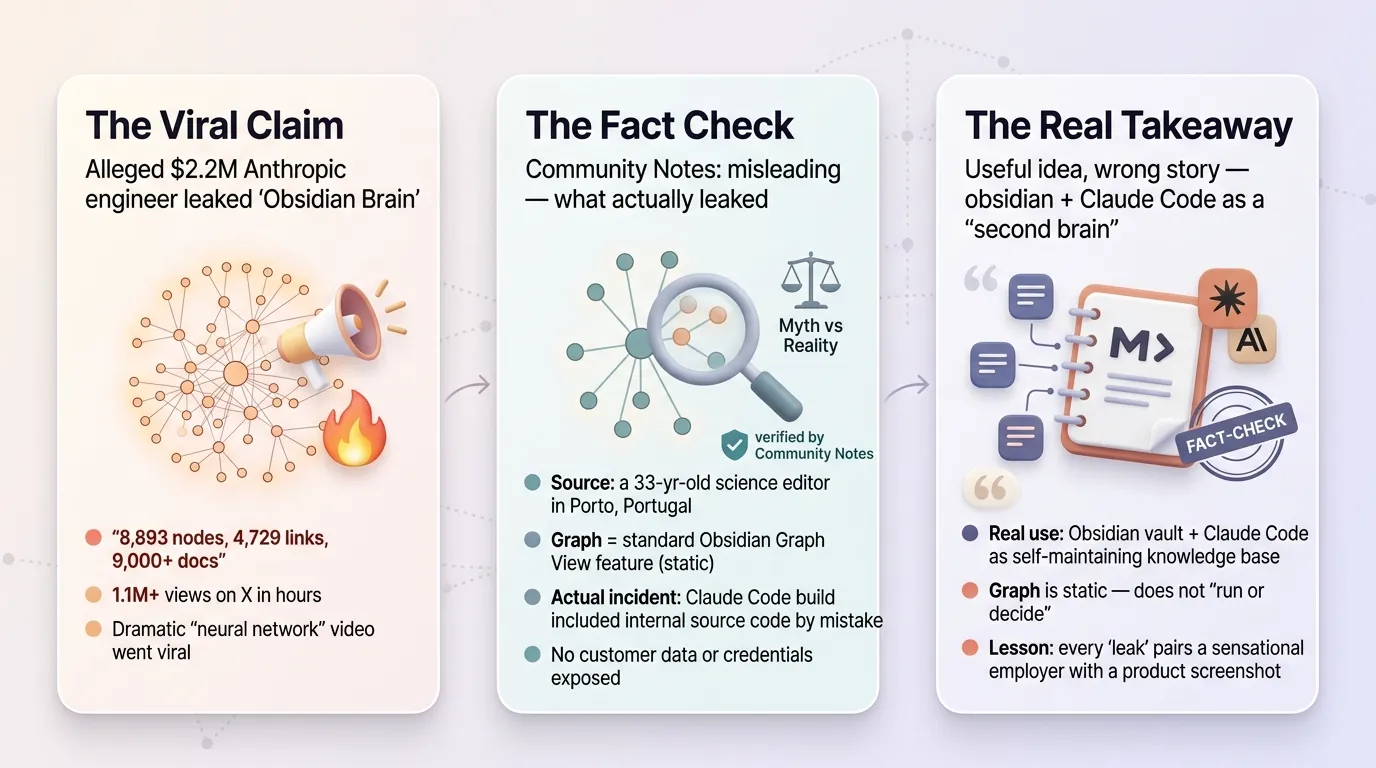
The viral post originated from an account called chewa. on X, which framed the story with cinematic flair — overlaying a mesmerising neural-network-style visualisation with captions referencing “21 inputs, 10+ hidden layers, ReLU activation,” and describing the graph as a “living brain that runs decisions” inside Anthropic. The clip spread at extraordinary speed, picked up by Instagram accounts, LinkedIn posts, and tech news aggregators, each iteration adding more sensationalism than the last.
However, X Community Notes — the platform’s crowdsourced fact-checking system — moved quickly to rate the central claim as misleading. Fact-checkers traced the source article referenced in the viral post not to an Anthropic engineer at all, but rather to a 33-year-old science journal editor based in Porto, Portugal — someone with no known connection to Anthropic whatsoever.
The dramatic “neural network” visualisation that viewers assumed was a glimpse into Anthropic’s classified AI architecture? It was simply Obsidian’s Graph View — a standard feature of the popular open-source note-taking application that renders linked markdown files as visual nodes. As critics on Reddit noted bluntly: “A knowledge graph doesn’t run or decide anything. It’s a static visualisation.”
The confirmed and verified account, pieced together from multiple sources including a Reddit post with 449 upvotes and an 89% approval ratio, tells a different story entirely. According to this account, what did actually occur at Anthropic was that a Claude Code software release accidentally included internal source code due to human error during the publishing process — not a deliberate leak by a disgruntled millionaire engineer.
Boris Cherny, the creator of Claude Code, responded to the incident by emphasising that the focus should be on improving the process, not on blaming any single individual. Importantly, Anthropic confirmed that no customer data or credentials were exposed in the incident.
For those wanting to understand the full context of what Obsidian actually is and why this viral post was so misleading, this breakdown explains it clearly: 📺 Watch: What Is an Obsidian Vault? The Viral Neural-Graph Post, Fact-Checked
What Is an Obsidian Brain — and Why Does It Look So Impressive?
To understand why so many people were fooled, it helps to understand what Obsidian actually is. Obsidian is a free, widely used note-taking application that stores information as plain markdown files on your local device.
What makes it distinctive is its Graph View feature — a visual rendering of all the connections between your notes, where each document becomes a glowing node and every internal link between documents becomes a line connecting them. When a person has thousands of well-connected notes, the result looks — quite strikingly — like a neural network firing across hidden layers in real time.
In reality, the graph is entirely static. It does not execute any code, run any inference, make any decisions, or contain any of the underlying model weights or proprietary architecture that would constitute a genuine trade secret. As one sharp-eyed Reddit commenter observed:
“GPT-1 had 117 million parameters. Current models are in the trillions. Way beyond what you can visualise. The network in the video has maybe 200 nodes. It’s a basic toy example.”
The viral video’s overlay text — labels like “HL3, Neurons: 37, Activation: ReLU (click)” — were simply the Graph View’s own interface labels being dramatically recontextualised to look like something far more technically significant than they were.
The real and legitimate takeaway buried beneath the hype, however, is that AI companies, developers, and researchers are increasingly using tools like Obsidian combined with agents like Claude Code to build sophisticated self-maintaining knowledge bases — what practitioners call a “second brain.”
When an agent like Claude Code is pointed at a vault of thousands of linked markdown files with proper conventions (folder semantics, a CLAUDE.md instruction file, ingest and lint routines), the result genuinely can function as a powerful, self-updating knowledge system. That is a real and fascinating development in how AI is reshaping knowledge management — it just does not require a $2.2 million engineer or a dramatic corporate leak to build one. 🧠💻
The episode is, ultimately, a perfect case study in how the internet processes AI news in 2026: a genuinely interesting technical concept wrapped in a sensational fictional narrative, turbocharged by engagement-farming social media accounts, spread by millions before the fact-checkers can catch up.
As one Reddit commenter put it with characteristic bluntness about the whole affair: “Every ‘leak’ is a marketing maneuver. That is the right prior when a post pairs a sensational employer with a product screenshot and no primary source.” 🔍
Quick Links: