Anthropic just announced that Claude will start embedding invisible watermarks into everything it writes. I’ve been watching the AI content space closely for years now, through every wave of “AI will kill content marketing” panic, and I want to share my honest read on this one, because I think most of the takes I’m seeing online are missing the actual point.
What Happened
Starting August 2, 2026, new Claude models weave an invisible, machine-readable signal directly into the text they generate. You can’t see it. It doesn’t change the writing itself. But it’s detectable, and Anthropic is reportedly building a detection API so others can check for it too.
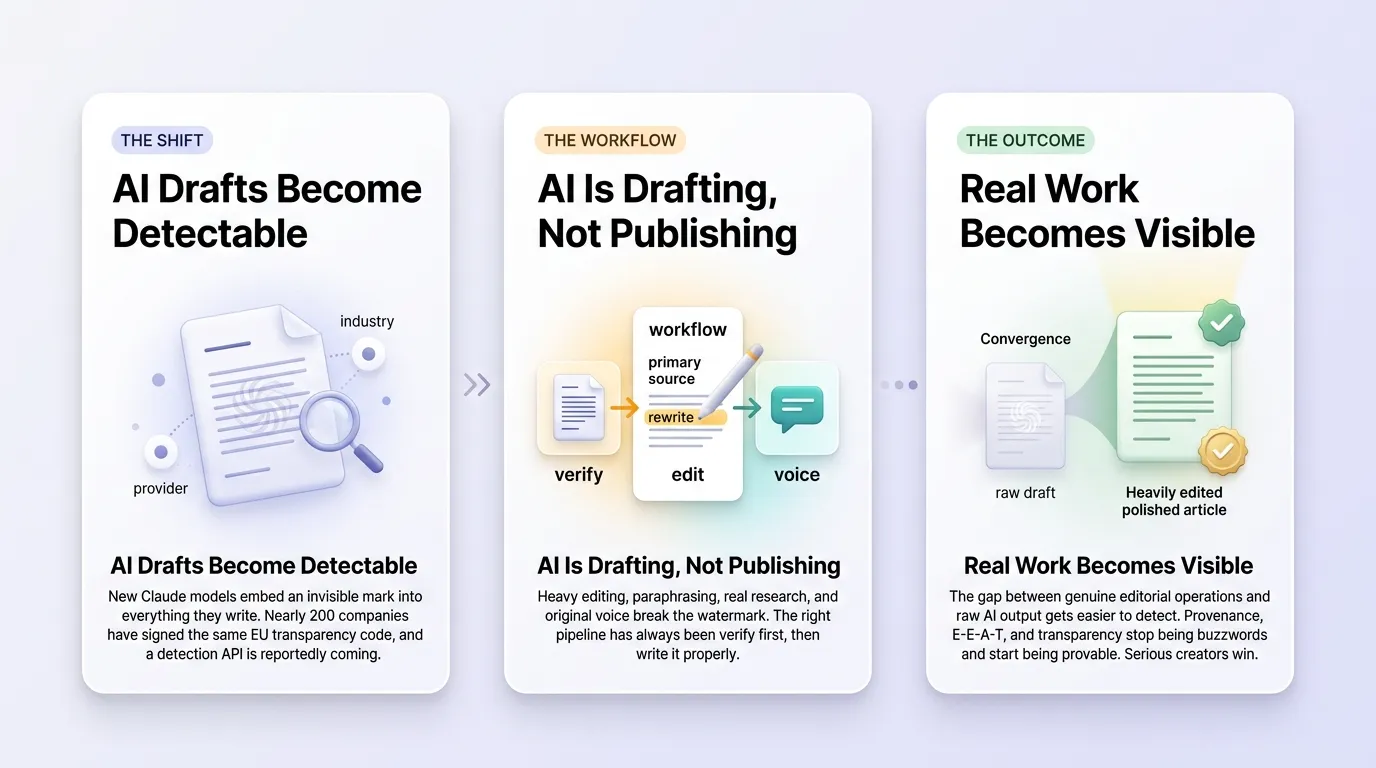
This is happening because of the EU AI Act, specifically a rule requiring AI companies to mark their output so it can be identified as machine-generated. Anthropic signed onto the EU’s transparency code, and so have nearly 200 other companies, including Google, Meta, Microsoft, and OpenAI. Google’s actually been doing something similar with images since 2023.
Here’s My Honest Reaction
I don’t think this is bad news. I think it’s overdue, and I think the people panicking about it are, frankly, the people who should be a little worried.
I’ve built an entire content operation, across multiple sites, multiple writers, and a genuinely high volume of output, on a simple principle: AI is a drafting tool, not a publishing tool. Every article that goes out under my name or my brands goes through verification, editing, and a real human pass that adds actual expertise and voice.
That’s not me being cautious for the sake of it, it’s the only approach that’s ever produced content worth reading.
And here’s the thing about this watermark: it degrades. Anthropic’s own reporting confirms it weakens or disappears with heavy editing, paraphrasing, translation, or when it’s genuinely mixed with independently written material. In other words, the exact workflow I’ve been running for years, verify first, then write it properly, naturally produces content where this watermark barely matters.
If your content strategy depends on publishing near-raw AI output at scale with minimal editing, this is a real wake-up call. If it doesn’t, this changes almost nothing about how you should already be working.
Why I Think This Is Actually Good for Serious Creators
Here’s my honest opinion, and it’s not a popular one in every corner of the content world: I think this makes the gap between real content operations and content mills more visible, not less. For years, anyone could publish thin, AI-generated content at scale and it looked, from the outside, identical to genuinely researched work. That’s getting harder now, not because AI got worse, but because the ecosystem is building the infrastructure to tell the difference.
That’s good for people who’ve actually been doing the work. It’s a problem for people who haven’t.
What I’d Tell Anyone Running a Content Business Right Now
-
Don’t panic. Audit instead. Look honestly at your pipeline. Where is AI output going out with real editing on top, and where is it going out close to raw? Fix the second category before it becomes a liability.
-
Disclosure isn’t weakness, it’s positioning. With nearly 200 major companies now compliant with transparency requirements, being upfront about how AI fits into your process is starting to look like the smarter long-term bet, not the riskier one.
-
This is an industry shift, not an Anthropic quirk. Google, Microsoft, Meta, and OpenAI are all moving the same direction. Build your strategy assuming this becomes standard everywhere, not just on Claude.
-
Keep doing what actually works. Real research, real verification, real editorial voice. That’s been the answer since before AI writing tools existed, and it’s still the answer now. The watermark just makes it a little more provable.
Youtube: Anthropic to watermark AI-generated text
Youtube: Claude Will Put Invisible Watermarks On AI Text And Images—And The Internet Isn’t Happy
X: https://www.threads.com/@cnn/post/Db7r0TCD1yt/video-anthropic-said-it-will-add-invisible-watermarks-to-text-generated-by-future/
Final Thought
I’ve said this before and I’ll keep saying it: AI doesn’t replace good content work, it changes what “doing the work” actually looks like. This watermark is one more piece of infrastructure pointing in the same direction the whole industry’s been heading, toward content that has to actually earn its place, not just exist at volume. That’s a shift I’m comfortable building a business around.
Quick Links: