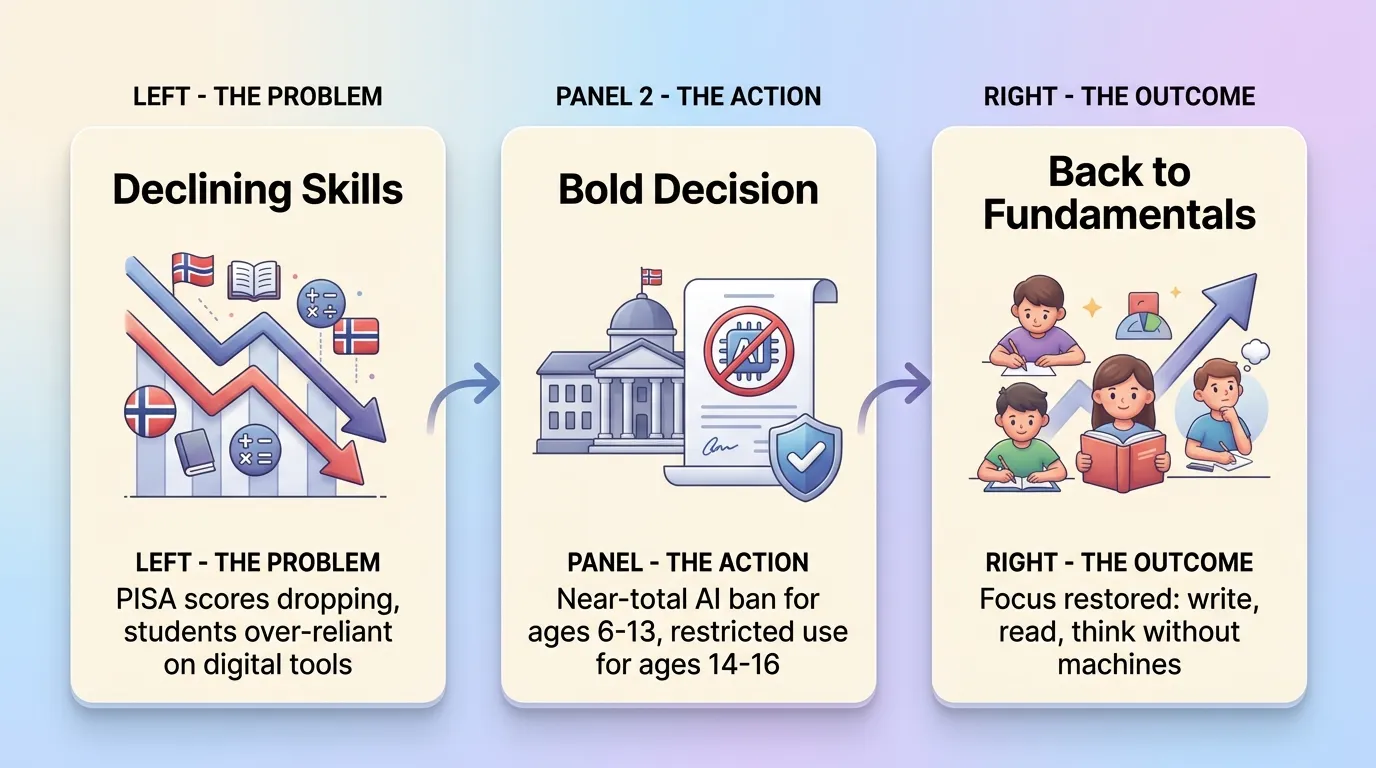
While much of the world races to integrate artificial intelligence deeper into classrooms, Norway has moved firmly in the opposite direction. On June 19, 2026, the Norwegian government announced one of the most sweeping AI restrictions in education seen anywhere in the developed world: a near-total ban on generative AI tools for all children in grades 1 through 7 — roughly ages 6 to 13 — effective from the new school year starting late August 2026.
Older students aged 14 to 16 will face strict limitations, only being permitted to use AI tools under direct teacher supervision. Students aged 17 and above are the only group permitted relatively unrestricted access.
The announcement was made by Prime Minister Jonas Gahr Støre, who was direct about the reasoning behind the move.
In remarks widely covered by Reuters and international outlets, Støre stated that excessive reliance on AI tools risks fundamentally undermining the development of essential cognitive and academic skills in children — the ability to write, to read independently, to reason through problems, and to think critically without a machine doing it for them. “The most important thing,” Støre said, “is that children learn to write, read, and think for themselves.”
📺 Watch the full WION News report: https://www.youtube.com/watch?v=FBCVoM0Za8E
What Triggered the Ban
Norway did not arrive at this decision suddenly. The country has been watching its national education data trend in the wrong direction for several years, and policymakers have been growing increasingly concerned.
Norway’s PISA mathematics and reading scores have shown a broad decline over recent testing cycles, a pattern that education officials have linked partly to growing student dependence on digital tools — including AI — to complete work that should be building fundamental cognitive skills.
This ban is the second major digital restriction Norway has imposed on its schools in quick succession. In 2024, the government already banned smartphones from classrooms entirely, a move that was broadly seen as successful in improving classroom focus.
The AI ban follows the same logic: if a device or tool is routinely substituting for the mental effort that builds long-term competence, it should be removed from the environment where that competence is supposed to be formed.
📌 Reuters original report: https://www.reuters.com/technology/norway-imposes-near-ban-ai-elementary-school-2026-06-19/
The Three-Tier System Explained
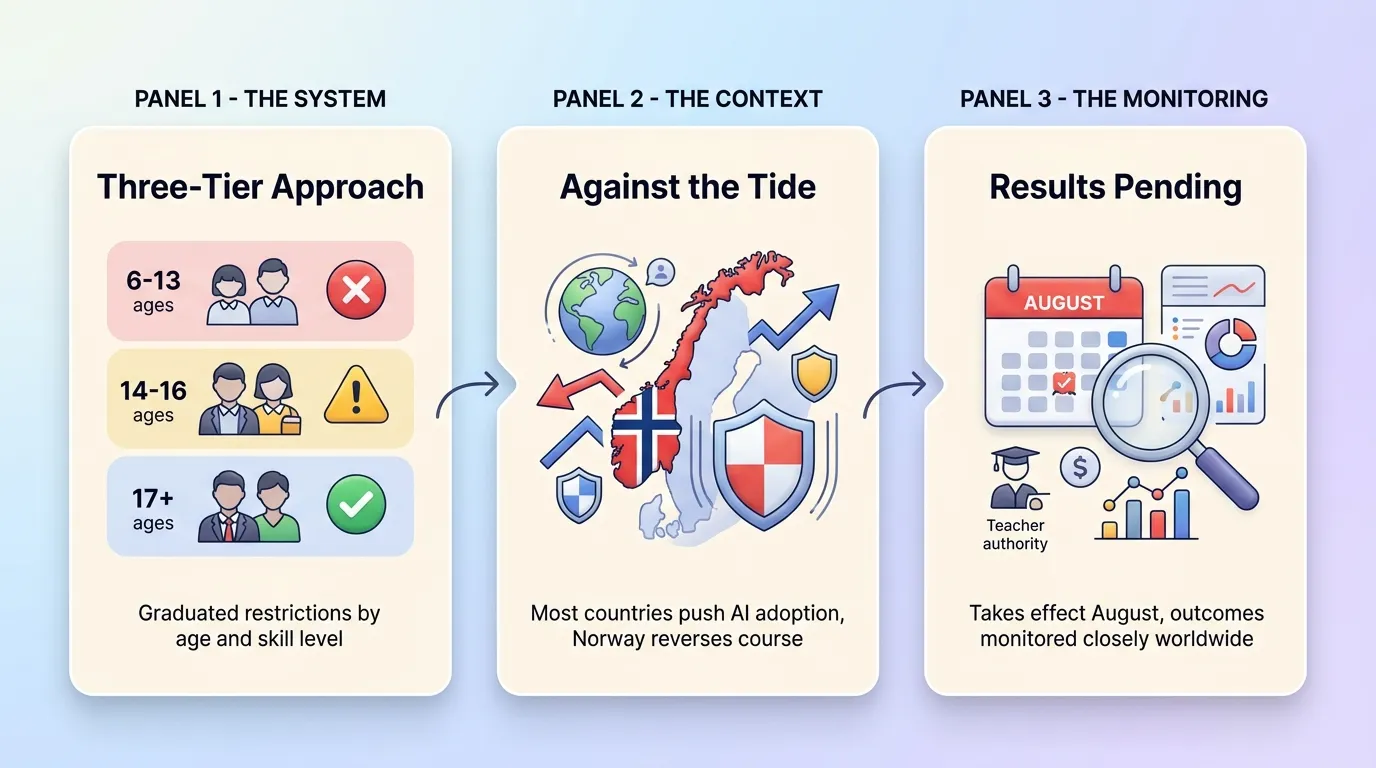
Norway’s approach is deliberately graduated rather than a blanket prohibition. The policy works in three tiers. Children in grades 1–7 (ages 6–13) face a near-complete restriction on all generative AI tools in school settings — this covers tools like ChatGPT and any comparable platform.
Students in lower secondary school (ages 14–16) are not banned outright but are restricted to AI use only when directly overseen by a teacher with a clear pedagogical purpose. Only students aged 17 and above — those in upper secondary school — are given more open access to AI tools, on the basis that by this age, foundational skills should already be firmly established.
🐦 Breaking post by Luiza Jarovsky, PhD on X: https://x.com/LuizaJarovsky/status/2069125922150551590
🐦 Reuters on X: https://x.com/Reuters/status/2068057536452792651
Global Context and Reaction
The announcement has generated significant international debate, arriving at a moment when most governments are moving in the opposite direction — pushing AI literacy into curricula from early years onward, piloting AI tutoring tools, and funding classroom AI adoption. Norway’s decision is a direct challenge to that consensus.
Supporters of the ban argue Norway is doing precisely what evidence-based policymaking looks like: observing declining outcomes, identifying a plausible contributing factor, and taking the courageous step of reversing course even when the broader cultural momentum points elsewhere.
Critics argue that restricting AI access will leave Norwegian students underprepared for a workforce and society that will be deeply shaped by these tools.
📺 YouTube Short — Norway AI Ban in Schools, Explained: https://www.youtube.com/shorts/EbLd9G4j1qM
🐦 Public reaction thread on X: https://x.com/Intellectualins/status/2068310395681751179
What Happens Next
The ban takes effect when Norwegian schools reopen for the autumn 2026 term in late August. Teachers have been given back expanded authority over classroom environments as part of this broader reform push, a trend that began with the 2024 smartphone ban.
The government has indicated it will monitor academic outcomes over the following school years to assess whether the restriction produces the measurable improvement in foundational skills it is designed to deliver.
Norway’s move will likely be watched closely by education ministries in other countries grappling with the same question: at what age, and under what conditions, should children interact with AI — and when does that interaction do more harm than good?
Quick Links: