Ford bet that AI could handle vehicle quality on its own. It could not. Over the past three years, the automaker has hired, rehired, or promoted 350 veteran engineers to clean up the mess its automated systems left behind. The company is now openly admitting the misjudgment, and the reversal is paying off in a big way.
Here is the core of it:
-
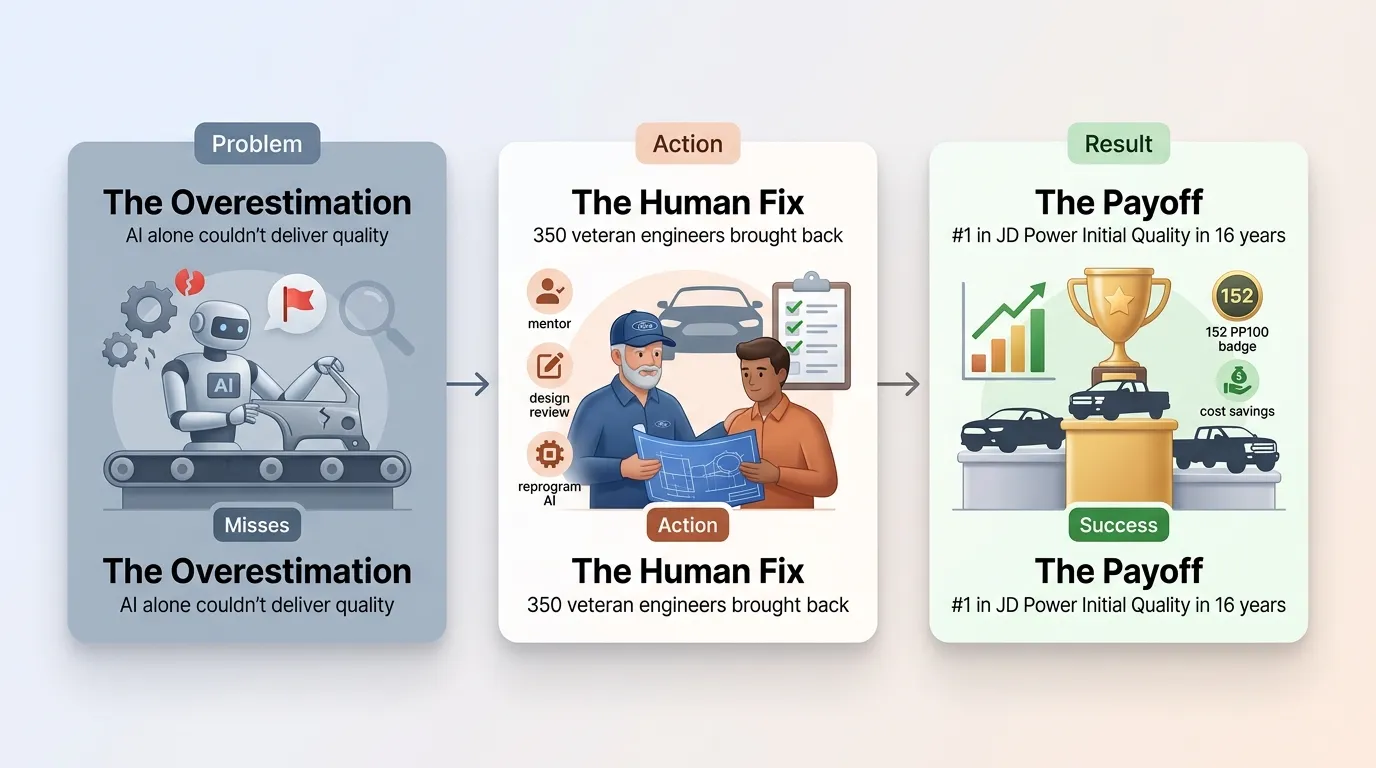
AI fell short. Ford leaned hard on automated quality systems, and they did not deliver the quality the company expected.
-
Humans came back. It brought in 350 experienced “gray beard” engineers to mentor junior staff and reprogram the AI tools.
-
It worked. Ford topped the JD Power Initial Quality Study among mainstream brands for the first time in 16 years.
https://www.youtube.com/watch?v=7zQ8UkLmUgM
What Ford got wrong
The admission came straight from leadership. Charles Poon, Ford’s vice president of vehicle hardware engineering, said the company mistakenly thought that introducing AI and feeding it design requirements would simply produce a high-quality product. It did not work that way.
The deeper problem was knowledge, not code. Many of Ford’s most experienced engineers left before they could transfer their judgment into the AI’s training data. Without that experience baked in, the automated tools amplified weak inputs instead of catching design flaws. The AI was only as good as the people who trained it, and the best people were already gone.
The human fix
So Ford brought experience back. It hired 350 veteran engineers, many of them former employees and others pulled from suppliers, to attack quality problems that had cost the company billions.
These engineers now run mandatory design reviews, hunt for failure points before a part reaches the plant floor, mentor younger staff, and rebuild the AI systems that underperformed.
Note the twist. Ford is not abandoning AI. It added more than 100,000 new AI-powered tests to catch edge cases. The lesson was not “drop the machines.” It was “let your most experienced people shape them.”
The payoff, and the catch
The results are real. Ford scored 152 problems per 100 vehicles to top JD Power’s 2026 study, ahead of Nissan and Buick, with the F-150, Mustang, and Super Duty each winning best in segment. CEO Jim Farley credited the turnaround with hundreds of millions of dollars in cost savings from lower warranty and recall expenses.
Here is the honest catch. The win does not erase a rough record. Ford has led US automakers in recalls this year, with 51 recalls covering more than 11 million vehicles.
The takeaway
This is the rare AI story that cuts against the “machines replace everyone” panic. Ford tried it, learned the hard way, and found that AI works best with experienced humans steering it, not instead of them. For anyone betting their workflow entirely on automation, that is the line worth remembering.
Quick Links: